A tank liner is a fiberglass barrier installed inside an existing underground storage tank. It seals internal corrosion and meets federal upgrade rules under 40 CFR 280.21. Relining a 10,000 gallon UST costs $5,000 to $15,000 and carries a 10 year warranty when installed under API RP 1631 or NLPA Standard 631.
That looks like a bargain against full UST replacement at $25,000 to $75,000 per tank. The math is rarely that simple. Several states have quietly stopped accepting internally lined tanks as compliant upgrades, and most warranties exclude the corrosion modes that actually kill old steel tanks.
This guide covers when interior lining is allowed, the installation process step by step, real cost data against full removal, state by state regulatory acceptance, and the scenarios where tank rehabilitation makes financial sense.
It also names the cases where relining is the wrong call. If your underground storage tank shows wall loss above 25%, carries any leak history, or sits in a state that voided lining as an upgrade method, the cheap option turns into a stranded asset.

What Is a Tank Liner and How Does Relining Work
A tank liner is a structural barrier bonded to the interior wall of an existing underground storage tank. The materials are usually fiberglass reinforced plastic, sprayed epoxy, or thick film polyurethane. The lining sits between the stored product and the original steel wall, blocking further internal corrosion and adding measurable structural reinforcement to the host tank.
UST relining starts with full product removal, tank cleaning, and a structural integrity assessment. A certified inspector enters the tank, measures wall thickness with ultrasonic gauges, and confirms that no section has lost more than 25% of original metal. Acceptable thickness varies by tank diameter but follows NLPA Standard 631 for steel UST relining and API RP 1631 for petroleum service.
Once the tank passes structural review, the interior surfaces get abrasive blasted to near white metal. Workers apply fiberglass mat in layers, saturating each layer with a polyester or vinyl ester resin. Total cured thickness is usually 120 to 180 mils, roughly 3 to 4.5 millimeters. The cured fiberglass tank liner forms a continuous monolithic shell inside the original steel tank.
After cure, the tank gets a tightness test under 40 CFR 280.43(c), which 40 CFR 280.33(d) requires within 30 days of a repair unless another allowed check is used. Cathodic protection is added externally if the original tank lacked it. The combined upgrade of interior coating plus cathodic protection satisfies the 1998 deadline requirements that still govern any single-wall steel UST remaining in service. Vet your installer using our how to choose a UST contractor checklist.
Federal Rules That Allow Tank Relining
The EPA upgrade deadline of December 22, 1998 forced every pre-1988 underground storage tank into one of three paths under 40 CFR 280.21. The options were to meet the new tank standards, close the tank, or upgrade it. Under 40 CFR 280.21(b), a steel tank could be upgraded with interior lining alone, cathodic protection alone, or both together.
The federal repair rule lives at 40 CFR 280.33. Repairs to metal USTs must restore tightness and follow nationally recognized standards. EPA references two acceptable lining standards by name: API RP 1631 (Interior Lining and Periodic Inspection of Underground Storage Tanks) and NLPA Standard 631, Chapter A (Entry, Cleaning, Interior Inspection, Repair, and Lining of Underground Storage Tanks). A tank lined without cathodic protection then needs periodic internal inspection.
A tank upgraded by lining alone must be inspected internally within 10 years of lining and every 5 years after that. The inspection checks for blistering, delamination, and undercut corrosion behind the lining. If the lined tank also has cathodic protection, 40 CFR 280.21(b)(3) sets no periodic lining inspection, but the cathodic protection must be tested at least every 3 years under 40 CFR 280.31. Inspection reports must be retained on site for at least three years and produced on demand during state UST program audits.
The 2015 EPA UST rule did not ban interior lining, but it tightened periodic walkthrough inspections and added secondary containment for new tank installations. Under 40 CFR 280.20, tanks and piping installed or replaced after April 11, 2016 must be secondarily contained, such as double-walled, and use interstitial monitoring. Lining technology only applies to existing single-wall steel tanks already in the ground before that date. Closure rules are covered separately in our tank decommissioning vs removal guide.
The Fiberglass Tank Liner Installation Process Step by Step
Tank emptying and degassing come first. A licensed UST contractor removes all product, then purges flammable vapors using forced ventilation until the lower explosive limit drops below 10%. Sludge and water bottoms get pumped, drummed, and shipped to a permitted facility. The generator must decide whether that waste is hazardous under 40 CFR 262.11, and if it is, RCRA hazardous waste rules apply.
Mechanical cleaning and surface preparation follow. Workers enter the confined space under an OSHA confined space permit, scrape interior walls, and remove rust scale. Abrasive blasting to SSPC-SP10 near white metal follows. Without that profile, the new fiberglass tank liner will not bond. Surface prep failures account for most delamination claims later in the warranty period.
Resin and fiberglass application is step three. Two part vinyl ester resin gets mixed on site and rolled or sprayed onto the prepared interior. Fiberglass mat is laid into the wet resin and consolidated by hand roller to eliminate voids. Each successive layer adds 40 to 60 mils. Most certified applicators target 120 mils minimum, with 180 mils on tank bottoms where condensate pools and corrosion runs hottest.
Cure, test, and documentation close out the job. Vinyl ester cures in 12 to 24 hours at typical site temperatures. A hardness reading using a Barcol gauge confirms full cure. The lined tank gets a tightness test under 40 CFR 280.43(c), and the owner keeps the repair records until the tank is closed, as 40 CFR 280.33(g) requires. Total job time runs three to five days per tank.
Tank Relining Cost Versus Full UST Replacement
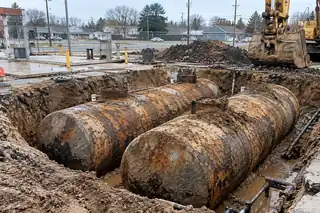
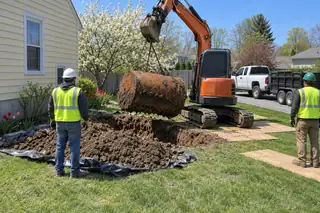
A single 10,000 gallon steel UST gets relined for $5,000 to $15,000 depending on tank condition, regional labor rates, and waste disposal fees. The same tank pulled and replaced with a fiberglass double-walled UST runs $25,000 to $75,000. A multi tank gas station replacement can clear $300,000 once piping, dispensers, and canopy work get added. The full breakdown sits in our UST removal cost guide.
That cost gap is real, but the asset life gap is bigger. A new double-walled fiberglass UST carries a 30 year manufacturer warranty and meets the 40 CFR 280.20 rule that new tanks be secondarily contained with interstitial monitoring. A relined steel tank typically carries a 10 year liner warranty that explicitly excludes the original steel substrate. Once the steel below the lining perforates, the warranty pays nothing.
Hidden costs eat into the savings. Confined space entry permits, vapor monitoring, hazardous waste disposal, and post lining tightness testing add $2,000 to $4,000 to a typical relining job. If contamination is found during the empty and clean phase, that triggers a closure assessment and can convert a relining project into a full removal project mid stream. Owners who budgeted for a $10,000 reline can suddenly face a $60,000 closure bill once soil sampling confirms a release.
Insurance and resale value tell the rest of the story. Pollution liability carriers typically rate a relined steel UST higher than a new double-walled fiberglass tank, sometimes by a factor of three. Buyers running Phase I ESAs on commercial property routinely demand removal of any lined tank older than 20 years before closing. The discount on resale often erases the lining savings.
State by State Acceptance of Lined Tanks
Federal rules allow interior lining as a valid 1998 upgrade pathway, but states can be more strict and several are. Maryland, Massachusetts, and Vermont stopped accepting newly installed liners as a compliant upgrade for commercial USTs after the 2015 EPA rule revision, citing field failure data. Owners in those states must replace or close non upgraded tanks rather than reline them.
New Jersey takes a middle path. The state still accepts existing lined tanks installed before 1998 as compliant if periodic internal inspections continue to pass, but does not allow new lining installations on commercial USTs. Homeowners with residential heating oil tanks face different rules entirely. See New Jersey UST contractors and tank installation in New Jersey for the current rules.
California regulates UST repairs under Title 23 of the California Code of Regulations, and the local Unified Program Agency must approve a repair, lining included, before work starts. Repairs must follow the tank maker's written guidelines, an industry code, or an engineering standard. Every single-walled UST in the state had to be closed by December 31, 2025, so lining cannot keep a single-walled tank in service there now. Local contractor capacity is mapped at California UST contractors.
Other states still permit lining, but the conditions differ by state. Ohio, for example, bars adding a field lining to an existing metal UST to meet corrosion protection rules, and cathodic protection may not be added to a previously lined tank there. Where lining is still accepted, the work follows a code such as NLPA Standard 631 or API RP 1631. If your state accepts lining and the steel is still sound, relining can be the right call.
When Tank Relining Is the Wrong Call
A tank with documented leak history is the most common wrong call scenario. EPA records under the LUST Trust Fund show that previously leaked tanks have a measurably higher rate of post lining failure within five years. If your tank ever triggered a release report or appears on a state LUST list, plan for full removal instead. The oil tank removal guide covers what a full removal involves and what it costs.
Heavy structural corrosion is the second disqualifier. Ultrasonic readings showing more than 25% wall loss in any zone put the tank below the structural floor that API RP 1631 and NLPA Standard 631 both require. A fiberglass tank liner installed over compromised steel is a stopgap that will fail within the warranty period. Look for pitting concentrated at the tank bottom and at the soil water table elevation, which are the two zones most likely to fail first after lining.
Tanks holding ethanol blends above E10 or biodiesel above B20 fail the third test. Many older interior coatings, particularly polyester based liners installed in the 1990s, are not chemically compatible with high oxygen content fuels. Vinyl ester is compatible with E15, B20, and ULSD, but verifying the resin chemistry against UL 87A listing is required before quoting. Florida closure rules for incompatible fuels appear in our tank decommissioning in Florida coverage.
Resale and lender pressure form the fourth wrong call category. Commercial real estate buyers running an ASTM E1527-21 Phase I ESA will flag any underground tank older than 25 years as a recognized environmental condition regardless of lining status. Lenders writing SBA 504 loans on properties with lined USTs often require removal as a closing condition. Owners planning to sell within five years should price removal not relining.
Choosing Between Relining Replacement and Decommissioning
Three honest questions determine the right path. First, will you continue to store product in this tank for at least 15 more years of service? If the answer is no, relining rarely pays back its installation cost before disposal becomes inevitable. Operators planning conversion to electric vehicle charging, for example, should price removal and decommissioning instead of lining work.
Second, what does an ultrasonic thickness survey show? If thin zones fail the criteria of the lining code being used, the tank cannot be lined, because 40 CFR 280.33 requires repairs to follow such a code. Replacement or closure is then the only compliant path. A thorough survey is part of tank inspection and testing and similar state level scopes that document tank wall integrity before any repair quote.
Third, what does the state UST regulator currently accept? State acceptance shifts year over year, and the program contact at your state environmental agency is the authoritative source. Document the agency response in writing before signing a lining contract. A verbal approval from a junior staffer will not survive a future audit. Email or letter is the only acceptable form of written confirmation for compliance file purposes.
Get three written bids before committing. Compare relining quotes against full removal and replacement quotes from contractors who can do both, and confirm each holds the state license the work needs. A serious bid will name the standard (API RP 1631 or NLPA Standard 631), the resin chemistry, the warranty terms, and the post installation testing protocol. Start at request a quote and ask each contractor to price both paths side by side.