Stage 1 vapor recovery is still federal law at stations moving 100,000-plus gallons a month. The federal Stage II requirement was waived effective May 16, 2012, and many states have since dropped it from their rules.
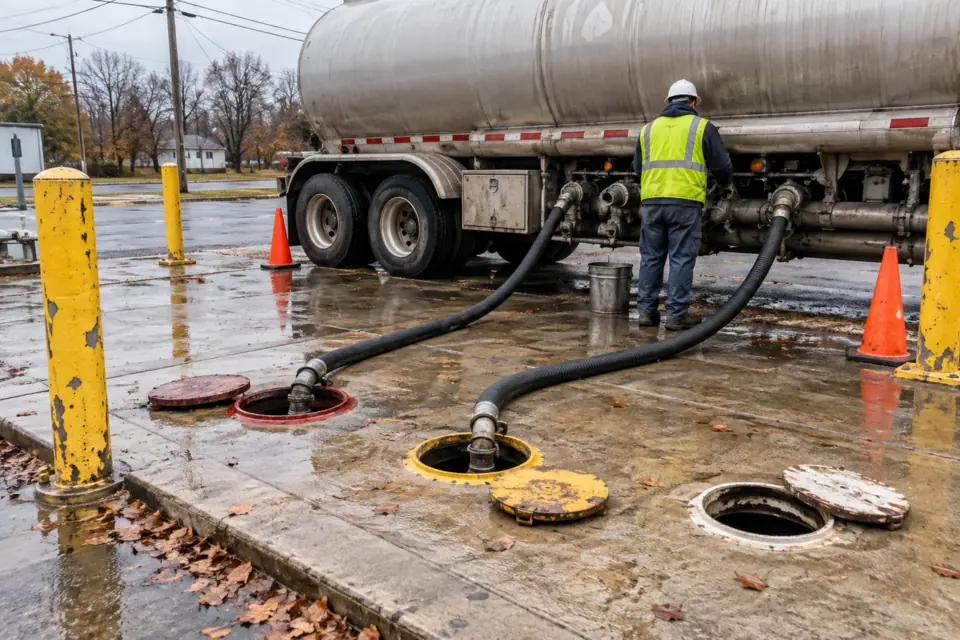
Stage I vapor recovery is the equipment that sends gasoline vapor, pushed out of an underground storage tank during a fuel delivery, back into the delivery truck. Its federal home is 40 CFR 63 Subpart CCCCCC, the gasoline dispensing facility rule EPA wrote under the Clean Air Act.
The pump-side counterpart, Stage II, has largely been replaced by onboard canisters in newer vehicles.
Owners of gas stations, convenience stores, marinas and fleet fueling sites face two practical questions. Does the delivery-side rule apply at my sales volume, and can the old nozzle hardware come out? The sections below cover the throughput lines, how often the equipment is tested, what a removal involves, and where states go past the federal floor.
What Is Stage 1 Vapor Recovery, and How Is It Different From Stage 2?
Stage I controls the delivery side of a station, while Stage II controlled the dispensing side. When a cargo tank unloads gasoline into a buried tank, the rising liquid pushes vapor out through the tank top. A vapor balance system closes the loop with pipes and hoses between the truck and the tank, so the displaced vapor flows into the cargo tank and leaves with the truck. Under 40 CFR 63.11112(a), the federal rule covers the storage tanks and the equipment used to unload cargo tanks into them. Equipment that refuels vehicles falls outside it.
Nozzle-side recovery came in two designs. Balance systems used a rubber boot that sealed the nozzle to the vehicle fill pipe, and vacuum assist systems put a vacuum pump on the vapor return line to pull vapor back toward the tank.
Onboard refueling vapor recovery (ORVR) moved that job into the car. ORVR is an activated carbon canister on the vehicle that captures refueling vapor inside the vehicle. Automakers phased it in starting with model year 1998, and it has been a required control on nearly all new highway vehicles since 2006. With canisters in widespread use across the fleet, EPA described the boot and vacuum systems and ORVR as redundant in its 2012 waiver rule, since both were capturing the same refueling vapor.
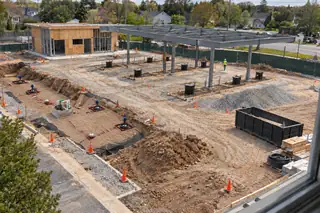
Hardware for the delivery side depends on age and volume. At sites dispensing 100,000 gallons per month or more, a new or reconstructed station, and any tank built after November 9, 2006 at an existing site, needs a dual-point vapor balance system. Dual-point means a separate entry port for the fill pipe and a separate exit port for the vapor connection. On a new build those ports belong in the tank equipment line of the gas station construction budget from the first estimate.
Does Your Monthly Throughput Trigger the Federal Rule?
Federal duties step up at two volume lines: 10,000 and 100,000 gallons of gasoline per month. Under 40 CFR 63.11111, a gasoline dispensing facility (GDF) below 10,000 gallons follows the work practices in 63.11116. At 10,000 gallons or more it follows 63.11117, which adds submerged filling. At 100,000 gallons or more it follows 63.11118, which adds a vapor balance system and the testing that goes with it.
Monthly throughput has a defined meaning in 63.11132, and it is a different number from any single month's sales. It is the total gasoline loaded into, or dispensed from, all gasoline storage tanks at the site for the current day plus the previous 364 days, divided by 12. A busy summer does not put a site over a line by itself, and a slow winter does not take it back under. The rolling average is the figure the rule counts.
The rule works like a one-way door. Under 63.11111(i), once throughput exceeds a threshold, the site stays subject to the requirements above that threshold even if sales later fall below it, and 63.11111(e) requires throughput records to be kept for 5 years. Recalculate the rolling figure every month from the delivery and dispensing records you already keep for fuel inventory control. Crossing 100,000 gallons even once locks the vapor balance and testing side of stage 1 vapor recovery onto that site for good, so the month to find out is the month before it happens.
Every GDF, at any volume, has to avoid handling gasoline in a way that releases vapor for extended periods. The rule gives four example measures: minimize spills, clean them up as quickly as practicable, cover open containers and fill pipes between deliveries with a gasketed seal, and minimize gasoline sent to open waste systems such as oil/water separators. From 10,000 gallons a month, gasoline goes into storage tanks only by submerged filling. Fill pipes installed on or before November 9, 2006 must end no more than 12 inches from the tank bottom, and pipes installed after that date no more than 6 inches from it. Tanks under 250 gallons are exempt from submerged fill.
How Often Is Stage I Equipment Tested?
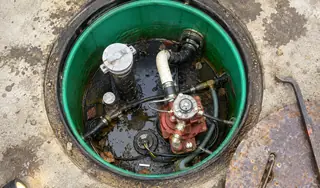
Vapor balance equipment is tested at installation and every 3 years after that, under 40 CFR 63.11120. Two demonstrations are required each cycle. The first covers the pressure/vacuum (PV) vent valves on the tank vent pipes, measuring leak rate and cracking pressure by CARB test procedure TP-201.1E or an approved alternative. The second is a static pressure test on the storage tanks, run by CARB TP-201.3, BAAQMD ST-30 or an approved alternative, to show the static pressure performance of the whole vapor balance system.
Valve settings are written into Table 1 of the subpart. A PV vent valve must be set at a positive pressure of 2.5 to 6.0 inches of water and a negative pressure of 6.0 to 10.0 inches of water. Other Table 1 design items include vapor connections and lines with closures that seal upon disconnect, a vapor-tight vapor line to the cargo tank, and vapor-tight caps on the liquid fill connections. Those windows are what the TP-201.1E cracking pressure reading is judged against.
Paperwork runs on both sides of the test. Under 63.11124(b)(4), the owner submits a Notification of Performance Test before the testing, and 63.11125 requires the results to be kept for 5 years and made available during a site visit. At a GDF of 100,000 gallons a month or more, Table 2 to the subpart also sets rules for each delivery. A cargo tank may not unload unless all vapor balance hoses are connected, the vapor return equipment is vapor-tight and compatible, all truck hatches are closed, and the cargo tank is vapor-tight. The truck proves that last point with documentation of its annual vapor tightness test. Without that document, the load stays on the truck.
Two different 3-year tests run on the same tank top, and the two are easy to confuse. The PV valve and static pressure tests are air rules under 40 CFR 63. The 3-year spill bucket test is a UST rule under 40 CFR 280 with its own calendar, set out in the 2026 UST compliance deadlines. Passing one says nothing about the other. Release detection and the other tank checks described under tank testing and inspection are a third set of duties again.
Is Stage 2 Vapor Recovery Still Required?
Stage 2 vapor recovery is no longer a federal mandate. In 77 FR 28772, EPA found ORVR in widespread use in the motor vehicle fleet and, effective May 16, 2012, waived the Clean Air Act section 182(b)(3) Stage II requirement for ozone nonattainment areas. A state that had been required to run a Stage II program could then remove it from its State Implementation Plan. Removal is a choice, and the state does it by submitting a SIP revision for EPA approval.
Stage II status is verified for 31 of the 51 jurisdictions (the 50 states plus DC). It has been removed in 28, is still required in 2 and was never required in 1. The other 20 are not verified and are shown that way rather than guessed.
California still requires Phase II vapor recovery at retail GDFs under air district rules, with the districts adopting the rules and CARB certifying the equipment. California's separate UST testing rules are covered on the California tank inspection and testing page. Washington still carries the requirement in its state rule, because WAC 173-491-040(5) has not been repealed. North Carolina never required it. Its nozzle recovery rules were contingency measures that were never activated, and they were repealed effective January 1, 2009.
According to EPA's 2012 rule, GDFs in up to 19 states and DC could seek to decommission their nozzle systems, about 30,600 GDFs in all. Other states had Stage II under separate federal or state requirements, so more states than that have removed it. The table below gives every state's status as still required, removed, never required, or not verified, with the removal year where known. It also shows whether the state's Stage I rule is stricter than federal where that is verified, with a link to its decommissioning rules, state rule or air agency.
| State | Stage II status | Stage I compared with federal | Where to check |
|---|---|---|---|
| Alabama | Not verified | Stricter rule | Air agency |
| Alaska | Not verified | Same as federal | Air agency |
| Arizona | Removed (2018) | Stricter rule and stricter testing | Decommissioning rules |
| Arkansas | Not verified | Same as federal | Air agency |
| California | Still required (air district rules) | Stricter rule and stricter testing | Air agency |
| Colorado | Not verified | Stricter rule | Air agency |
| Connecticut | Removed (2015) | Stricter rule and stricter testing | Decommissioning rules |
| Delaware | Removed (2020) | Stricter rule and stricter testing | Decommissioning rules |
| District of Columbia | Removed for new stations and vacuum assist (2022); balance systems stay | Stricter rule | EPA SIP notice |
| Florida | Removed (2012) | Stricter rule | State rule |
| Georgia | Removed (2015) | Stricter rule and stricter testing | Air agency |
| Hawaii | Not verified | Same as federal | Air agency |
| Idaho | Not verified | Stricter rule | Air agency |
| Illinois | Removed (2014) | Stricter rule and stricter testing | Decommissioning rules |
| Indiana | Removed (2016) | Stricter rule | Decommissioning rules |
| Iowa | Not verified | Same as federal | Air agency |
| Kansas | Not verified | Stricter rule | Air agency |
| Kentucky | Removed (2016) | Stricter rule | Decommissioning rules |
| Louisiana | Removed (2020) | Stricter rule | Decommissioning rules |
| Maine | Removed (2012) | Stricter rule | Decommissioning rules |
| Maryland | Removed (2016) | Stricter rule and stricter testing | Decommissioning rules |
| Massachusetts | Removed (2015) | Stricter rule | EPA SIP notice |
| Michigan | Removed (2006) | Not verified | Air agency |
| Minnesota | Not verified | Stricter rule | Air agency |
| Mississippi | Not verified | Same as federal | Air agency |
| Missouri | Removed (none allowed after 2015) | Stricter rule | Air agency |
| Montana | Not verified | Not verified | Air agency |
| Nebraska | Not verified | Not verified | Air agency |
| Nevada | Removed in Washoe County; Clark County not verified | Stricter rule | Decommissioning rules |
| New Hampshire | Removed (2012) | Stricter rule | Decommissioning rules |
| New Jersey | Removed (2017) | Stricter rule and stricter testing | Decommissioning rules |
| New Mexico | Not verified | Stricter rule | Air agency |
| New York | Removed (2021) | Stricter rule | EPA SIP notice |
| North Carolina | Never required | Stricter rule | Air agency |
| North Dakota | Not verified | Not verified | Air agency |
| Ohio | Removed (2014) | Stricter rule | Decommissioning rules |
| Oklahoma | Not verified | Stricter rule | Air agency |
| Oregon | Removed (being phased out) | Stricter rule and stricter testing | Decommissioning rules |
| Pennsylvania | Removed (2022) | Stricter rule and stricter testing | Decommissioning rules |
| Rhode Island | Removed (2013) | Stricter rule and stricter testing | Decommissioning rules |
| South Carolina | Not verified | Same as federal | Air agency |
| South Dakota | Not verified | Same as federal | Air agency |
| Tennessee | Removed (2016) | Stricter rule | Decommissioning rules |
| Texas | Removed (2014) | Stricter rule and stricter testing | Decommissioning rules |
| Utah | Not verified | Stricter rule | Air agency |
| Vermont | Removed (2013) | Stricter rule | Decommissioning rules |
| Virginia | Removed (2014) | Stricter rule | Decommissioning rules |
| Washington | Still in state rule | Stricter rule | State rule |
| West Virginia | Not verified | Stricter rule | Air agency |
| Wisconsin | Removed (2013) | Stricter rule | Decommissioning rules |
| Wyoming | Not verified | Same as federal | Air agency |
What Does Stage II Decommissioning Involve?
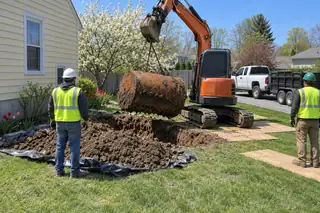
Stage II decommissioning is the removal of nozzle-side vapor equipment from service under a written procedure, and the state procedures checked for this guide most often cite PEI RP300 Chapter or Section 14. RP300 is the Petroleum Equipment Institute's recommended practice for vapor recovery systems. The typical state sequence has two paperwork steps around the field work: a notice to the air agency before it starts, and a completion notice or checklist after it ends. No national deadline applies, because each state sets its own.
Kentucky shows how specific a state procedure can get. Under 401 KAR 59:174, Stage II decommissioning follows PEI/RP300-09 Chapter 14, a notice of intent goes in at least 30 days before work starts, and the work is completed within 60 days of starting.
Stage I duties continue after the nozzle side comes out, and a site at 100,000 gallons per month or more keeps its 3-year PV valve and static pressure tests. The removal itself can reach the tank top, with vapor piping sealed at the tank end, PV vent valves fitted where needed and a pressure decay test run. To price a removal, a quote request should name the system type, the number of dispensers and fueling positions, the state notice form, and whether the site still runs the original boots or vacuum assist nozzles.
A boot on the nozzle does not prove a balance system. EPA's 2012 rule notes that vacuum assist nozzles can use a smaller, lighter boot or none at all.
Where State Stage I Rules Go Further
Most states go past the federal Stage I rule. Of the 51 jurisdictions, 39 have a verified Stage I rule stricter than federal, through a lower or no throughput threshold, regional rules, or stricter equipment. Twelve of those 39 also have verified stricter Stage I testing. Another 8 are verified as matching federal on both counts.
The tradeoff sits at the bottom of the federal scale. Below 10,000 gallons a month the federal rule asks only for work practices, and a small station owner can read that as no equipment duty at all. With 39 of 51 jurisdictions running a stricter rule, a low federal number can still leave a site with state submerged fill, vapor balance or testing duties that start lower, or with no volume floor at all. The federal tier is where the analysis starts, and the state rule decides where it ends.
Vapor recovery is an air quality rule, so it usually sits with the state air agency or a local air district rather than the state tank program. The full list of tank-side duties, from registration to release detection to operator training, is set out in the UST compliance guide for facility owners.
Regional rules are easy to miss, because two stations a few miles apart can fall under different requirements when a county line or air district boundary runs between them.
Which Sites Can Skip Vapor Balance Equipment?
Sites under 100,000 gallons a month skip vapor balance under the federal rule, and so do some tanks at larger sites. Under 63.11118(c), three tank types follow the 63.11117 requirements instead of the vapor balance rule: tanks under 250 gallons built after January 10, 2008, tanks under 2,000 gallons built before that date, and tanks with floating roofs. Floating-roof tanks, and tanks from 250 to under 2,000 gallons built before that date, load by submerged fill. Any tank under 250 gallons drops to the work practices alone, because 63.11117(c) exempts it from submerged fill.
The rule reaches well past retail stations. A GDF is any stationary facility that dispenses gasoline into the fuel tank of a motor vehicle, a nonroad vehicle or a nonroad engine, a category that takes in lawn equipment, boats, generators and pumps. A farm, a marina, a school bus yard or a municipal garage that fuels its own equipment from a gasoline tank is a GDF, and the same throughput lines apply to it. Fleet sites also keep the same 5-year throughput records as a busy highway station, even when no one there thinks of the place as a gas station.
Each state page of the UST contractor directory lists firms with their contact details and services. Before booking an air test, ask any firm you call whether it runs TP-201.1E and TP-201.3.
The costly mistake belongs to a site that passed 100,000 gallons in one busy rolling year and then fell back under it. If it did not run the 3-year PV valve and static pressure tests or file the Notification of Performance Test by the dates 63.11113 sets, it is out of compliance, because 63.11111(i) keeps it subject. The throughput records it must keep for 5 years show when it crossed. The test results 63.11125 says it must produce at a site visit were never created.