Shop-built oil tanks at SPCC facilities need regular integrity inspections, commonly under STI SP001. SP001 is the Steel Tank Institute's inspection standard, and EPA says it may be used to meet the integrity testing rule in 40 CFR 112.8(c)(6). That rule names no inspection frequency and no inspector qualifications, so the standard supplies both.
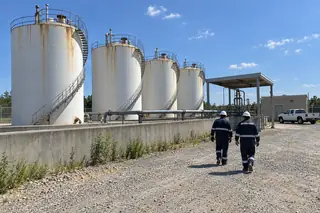
The tanks in question sit at fleet yards, generator sites, bulk plants and municipal yards. Whoever keeps the SPCC plan at those sites needs four answers: whether a tank needs a formal inspection, how often it is due, who may perform it, and what it costs.
Decide one thing first: a shop-built tank goes to SP001, and a field-erected tank built to API 650 goes to API 653.
The tradeoff is staff time against inspector fees. Monthly and annual owner checks under SP001 cost no inspector fee, yet they never replace the formal inspections the standard schedules for a certified inspector. A facility that skips the formal ones to save the fee is not following the standard its SPCC plan cites.
Does Your Tank Need an STI SP001 Inspection?
Two conditions make SP001 the standard to consider: the facility falls under the SPCC rule, and the tank is a shop-built aboveground container. EPA notes that many SPCC facilities use shop-built containers and that SP001 may be used to meet the integrity testing rule for them, and the facility's SPCC plan records which standard it follows. That choice then decides who may inspect the tank and how.
Coverage starts with 40 CFR 112.1. The SPCC rule exempts a facility on capacity grounds only when two limits both hold: aggregate aboveground oil capacity of 1,320 gallons or less, counting containers of 55 gallons or more; and completely buried capacity of 42,000 gallons or less. A separate exemption covers a facility that, given its location, could not reasonably be expected to send oil into navigable waters. Two 1,000-gallon tanks at a fleet yard total 2,000 gallons and cross the aboveground line. The SPCC plan guide covers how containers of every kind count toward the threshold and when a facility must write a plan.
Shop-built, in EPA's guidance, means a container shop-assembled in one piece before transport to the installation site. Such tanks generally have lower capacities and smaller diameters than field-erected tanks, with fewer welds. SP001's scope, per EPA's tank inspection page, covers aboveground shop-fabricated tanks, small field-erected tanks, portable containers, and associated secondary containment, which puts the dikes around a tank inside the job. The institute's own page adds 55-gallon drums and intermediate bulk containers of metal or plastic.
The core of the SPCC tank inspection requirements is one paragraph, 40 CFR 112.8(c)(6). Each aboveground container needs integrity testing or inspection on a regular schedule, and again "whenever you make material repairs," and the owner must keep comparison records and inspect supports and foundations. The rule leaves qualifications and frequency to industry standards, which must account for how the container is built: shop-built, field-erected, skid-mounted, elevated, lined, double-walled or partially buried. Past that point, tank integrity testing follows whatever standard the plan names. Facilities storing animal fats or vegetable oils carry a parallel duty under 40 CFR 112.12(c)(6), which requires formal visual inspection, in place of integrity testing, for certain elevated stainless steel containers covered by FDA food rules.
How Often Are SP001 Inspections Due?
SP001 inspections run on two tracks. The owner inspects every month and every year, and a certified inspector carries out formal external and internal inspections where the standard's table calls for them, on a schedule set by tank category and size. A material repair adds one more, since 40 CFR 112.8(c)(6) requires a test or inspection whenever you make one.
The federal rule supplies no dates. EPA's FAQ on SPCC inspection schedules says the rule "does not prescribe a specific frequency or methodology" and relies instead on good engineering practices and industry standards. EPA's guidance identifies the schedule as the standard's Table 5.5 and says that table "places tanks into one of three categories and establishes different requirements regarding the type and frequency" of owner and formal inspections.
Owner inspections need no outside credential. STI's checklists say the monthly visual inspection "does not require a Certified Inspector" and "shall be performed by an owner's inspector," and the annual checklist is completed as a supplement to the monthly ones. Federal text adds a floor of its own: the owner "must frequently inspect the outside of the container for signs of deterioration, discharges, or accumulation of oil inside diked areas."
The current text is the 7th edition of Steel Tank Institute SP001, published in February 2024, and the institute's presentation on the update says "All inspection schedules are unchanged" from the edition before it. One provision spares some tanks an internal entry: STI says SP001 "does not mandate entry into a tank for any tank under 30,000 gallons" if it is Category 1 with spill control, continuous release detection and overfill protection.
Is a Visual Check Enough Above 5,000 Gallons?
A visual check by the owner is usually not enough for a tank larger than 5,000 gallons. EPA's Bulk Storage Container Inspection Fact Sheet of August 2013 and Chapter 7 of the agency's SPCC Guidance for Regional Inspectors carry the same sentence on the point. According to the fact sheet, "For tanks larger than 5,000 gallons, most industry standards require more than a visual inspection by the owner or operator."
More than visual means tank integrity testing that measures the container itself. The federal rule names visual inspection, hydrostatic testing, radiographic testing, ultrasonic testing, acoustic emissions testing, and other non-destructive methods as examples. Ultrasonic thickness testing sends sound through the steel to measure how much wall remains at marked points on the shell. Each reading means most when set against an earlier one taken at the same point, and that is the purpose of the comparison records the rule requires. A tank with no earlier readings on file shows its present thickness and nothing about its rate of loss.
Integrity testing of that kind may call for outside help. Under SP001 that help is the certified inspector, while the owner's inspector keeps the monthly and annual checklists. The fact sheet reads: "While frequent external visual inspections can often be completed by trained facility personnel, the requirement to conduct regular integrity tests or inspections may involve hiring specialized personnel (as specified by the applicable industry standard)."
The 5,000-gallon figure also marks a line in the SPCC plan rules. Under 40 CFR 112.3(g), a facility with any single aboveground container over 5,000 gallons cannot use the Tier I qualified facility path, even when the rest of its profile fits. One tank above that size therefore ends Tier I eligibility and, under most industry standards, passes the point where an owner's visual check suffices.
Who Can Perform a Formal STI Tank Inspection?
A formal STI tank inspection must be performed by a certified inspector, meaning a person certified by STI or an API 653 inspector who holds the SP001 adjunct certification. EPA's guidance lists the inspector options as "Certified inspector (either by API 653 with STI adjunct certification or STI) or owner's inspector," and reserves formal external and internal inspections for the certified one.
The institute's own credential is earned in a classroom. Its course runs Monday through Friday, and STI lists a 2026 regular attendee rate of $2,395. Candidates qualify with a Bachelor of Science degree plus at least one year of related experience, a two-year degree plus two years, or a high school diploma plus three years. Passing the two-part exam takes "80% total combined with no section under 70%," and the certification expires after 5 years.
API 653 inspectors have a shorter route. The SP001 adjunct certification is an online course ending in a 40-question exam with an 80% passing score, and it also expires in 5 years. The owner's inspector needs no certification. That role falls to the owner or a designee, who completes the AST Record along with the monthly and annual checklists. Either certified path leads to the authority STI describes on its certification page: "An SP001 Certified Inspector can perform formal AST inspections and determine whether a tank is suitable for continued service."
Confirm the credential yourself before an inspection is booked. STI's Find an Inspector page links to its SP001 inspector directory, which is searched by location. Firms that do tank inspection and testing work are listed in the directory of tank contractors by state, and a listing there says nothing about whether anyone at the firm holds an STI or API credential. Ask for the inspector's name and certification expiration date with the quote. Both the STI credential and the adjunct lapse after 5 years.
SP001 or API 653: Which Standard Fits Your Tank?
The way a tank was built picks the standard. A tank that arrived in one piece falls under SP001. One welded together on its own foundation to API 650 falls under API 653, which EPA's fact sheet says "is typically used to establish an integrity testing program for field-erected tanks."
The agency's guidance draws the line by construction: API 653 covers field-fabricated welded or riveted atmospheric tanks built to API 650 or its predecessor, API 12C. Two overlaps blur that line, since SP001 also reaches small field-erected tanks and an API 653 inspector with the SP001 adjunct certification can work to either standard.
An API 653 inspection follows its own intervals and scope, covered in the API 653 tank inspection guide. A bulk plant or tank farm that holds both kinds of tank can end up running two programs, one per standard, under a single SPCC plan.
Non-portable shop-fabricated plastic or fiberglass tanks are the named exception. STI's SP001 page leaves them out of scope, and API 653 covers field-fabricated welded or riveted tanks, so the SPCC plan must cite another industry standard for them.
What Does an SP001 Inspection Cost?
Three federal awards for SP001 and STI inspections came to $7,912, $9,629 and $11,084, each a lump sum with no tank sizes stated.
USAspending.gov, the Treasury's public record of federal spending, holds all three. At New London, Connecticut, a Coast Guard award from September 2022 came to $7,912 for in-service inspections of five aboveground storage tanks to the SP001 6th edition. An Army Corps of Engineers award at Fort Greely, Alaska, came to $9,629 in April 2025 for two STI inspections. In August 2024 the Federal Bureau of Prisons at Victorville, California, paid $11,084 for one mandatory SP001 inspection.
Those three figures are public records, and a per-tank average drawn from them would mislead. None of the awards gives a tank size, and a lump sum can include travel and the cost of reaching a remote site. Two other costs sit on the owner's side: STI sells the standard for $235 to non-members, and the monthly and annual checklists cost staff time but no inspector fee.
A useful quote request lists the tank count, each capacity, whether each tank is shop-built or field-erected, and the date and findings of the last formal inspection. Those details let every bidder price the same scope when you ask for quotes, so the bids can be compared line by line. An inspection that finds a tank unfit for continued service moves the decision to retiring the tank, and the ways out are compared in tank decommissioning versus removal.
Where Are the Free SP001 Checklists, and What Do You Do With Them?
STI posts the SP001 checklists free, with no login, on its SP001 standard page: the AST Record, the Monthly Inspection Checklist, the Annual Inspection Checklist, and a Portable Container Monthly Inspection Checklist. Together they give a facility a ready fuel tank inspection checklist set for the owner's half of the standard. Our SPCC plan template page covers these checklists alongside EPA's Tier I plan template.
Fill in the monthly checklist every month and the annual checklist once a year, and keep every completed copy. The checklist text says to "Retain the completed checklists for at least 36 months," and the formal inspection reports belong in the same file, since the federal rule also requires comparison records. The monthly form "is intended as a model," and STI accepts locally developed checklists "as long as they are equivalent and meet all applicable inspection checklist items," which lets a site add its own valve and gauge numbers.
Those checklists and the AST Record document the owner's inspections. STI's own note marks the limit of the paperwork: "the utilization of the AST record and the checklists alone do not constitute compliance with STI SP001."
The test is the standard's table. Once it puts a formal inspection due, no stack of monthly checklists stands in for a certified inspector's report.