API 653 inspection keeps aboveground petroleum storage tanks legally operating. The American Petroleum Institute first published the API 653 standard in 1991, and the federal SPCC rule at 40 CFR 112.8(c)(6) requires container integrity testing under industry standards, a role API 653 commonly fills. Bulk plants, tank farms, refineries, and any facility holding more than 1,320 gallons of oil in aboveground containers fall inside that requirement.
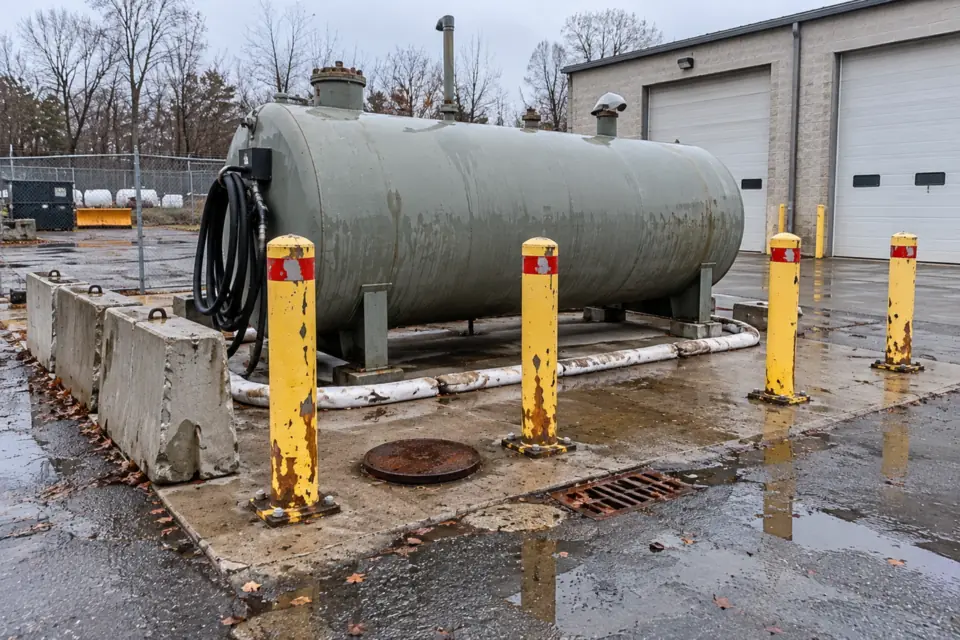
The standard splits inspection into three buckets. Owners or operators perform routine monthly walkdowns while the tank is running. A qualified API 653 inspector handles external inspections on a five-year cycle without taking the tank offline. Full internal inspection by an API 653 certified inspector falls due every ten to twenty years depending on bottom corrosion rate. Skipping the cycle exposes operators to enforcement under federal Clean Water Act authority, state petroleum storage tank rules, and insurance non-coverage for any release.
This guide walks through what the API 653 standard covers, who holds the certification to sign the report, and how cost varies by tank size. It also covers what changes between an external review and a full internal exam, and how state agencies fold API 653 into their AST programs. The audience is terminal managers, refinery facility engineers, bulk plant owners, and farm cooperatives holding large field-erected aboveground tanks.
If your last full inspection date is fuzzy, the most useful next step is to pull the tank file and find the report cover page before doing anything else.

What API 653 Inspection Covers and Why It Exists
API 653 is the American Petroleum Institute's standard for inspection, repair, alteration, and reconstruction of welded aboveground petroleum storage tanks operating at approximately atmospheric pressure. It covers carbon and alloy steel tanks built to API 650 or its predecessor API 12C, and EPA's SPCC guidance calls it the standard typically used for field-erected tanks. Shop-built tanks, assembled in one piece before they are shipped, usually fall to STI SP001 instead.
The federal SPCC rule at 40 CFR 112.8(c)(6) directs facility owners to test or inspect each aboveground container for integrity on a regular schedule and whenever material repairs are made. EPA accepts API 653, STI SP001, or comparable industry standards as the engineering basis for that inspection. Without one of those formal programs, a facility cannot demonstrate SPCC compliance during an EPA inspection or a state agency audit.
The API 653 standard exists because welded carbon-steel tanks corrode predictably from the inside, especially along the bottom plate where water collects under the product layer. A 50-year-old asphalt or fuel oil tank with no documented inspection history is essentially uninsurable, and a single bottom plate failure can drive cleanup costs into the seven figures. API 653 puts a defensible engineering cycle around that risk.
Owners often confuse API 653 with API 650. The construction standard API 650 governs how a new welded steel storage tank is designed, fabricated, and erected at the build site. API 653 takes over the moment that tank is commissioned and stays in force for the rest of its operating life. Both standards apply during a typical tank lifecycle.
External and Internal Inspection Intervals
API 653 defines three inspection categories with very different scopes and intervals. Routine monthly walkdowns are performed by the owner or operator. External inspections happen on a five-year cycle by a qualified API 653 inspector while the tank stays online. Full internal evaluation requires the tank to be drained, cleaned, gas-freed, and entered by an API 653 certified inspector. Each carries its own interval and documentation rules.
Routine monthly walkdowns happen as part of a broader API 653 inspection program. A trained facility employee walks the tank exterior, checks for visible shell distortion, foundation settlement, paint failure, leaks at appurtenances, and condition of secondary containment. The owner records the walk-through on a standard checklist and keeps it with the tank file for the next certified inspector to review during the formal external visit.
External inspections occur at intervals not exceeding five years, or based on a corrosion rate calculation that may shorten the cycle. A qualified API 653 inspector visually examines the tank shell, takes ultrasonic thickness readings on each shell course, evaluates the foundation, and reviews owner records from the previous five years. The tank keeps running throughout the external visit, and no shutdown is required.
Internal inspection drives the longest interval and the largest cost on the cycle. The default window is ten years from initial commissioning for the first internal exam, then governed by measured bottom plate corrosion rate up to a maximum of twenty years between exams. The tank is drained, cleaned, and entered for evaluation including floor magnetic flux leakage scanning, shell plate evaluation, and roof assessment.
What a Certified API 653 Inspector Checks
An API 653 certified inspector holds a current certification administered by API through the Individual Certification Programs. Certification requires documented inspection experience, passage of a closed-book and open-book exam covering the API 653 standard, related codes such as API 650 and API 575, and recertification every three years. Only certified individuals can sign the inspection report and reset the interval clock.
Shell evaluation is the most data-heavy part of any AST inspection or broader tank integrity inspection program. The inspector takes ultrasonic thickness readings across each shell course, calculates the minimum thickness required for the next inspection interval, and compares measured values to API 653 minimum thickness equations. Sections that fail are flagged for repair, re-rating to a lower fill height, or replacement.
Bottom plate evaluation drives most repair scope on an internal API 653 inspection. Magnetic flux leakage scanning maps soil-side corrosion across the entire floor, and ultrasonic verification confirms the worst pits. The inspector evaluates findings against API 653 acceptance criteria and recommends patching, partial replacement, or a full new bottom depending on the percentage of plate below minimum thickness.
Foundation, roof, appurtenances, and nozzles round out the tank integrity inspection. The inspector measures any tilt or settlement of the ringwall, looks at the roof seal area on floating-roof tanks, evaluates manway and nozzle reinforcement, and checks venting and overfill protection. All findings flow into a stamped report retained for the life of the tank.
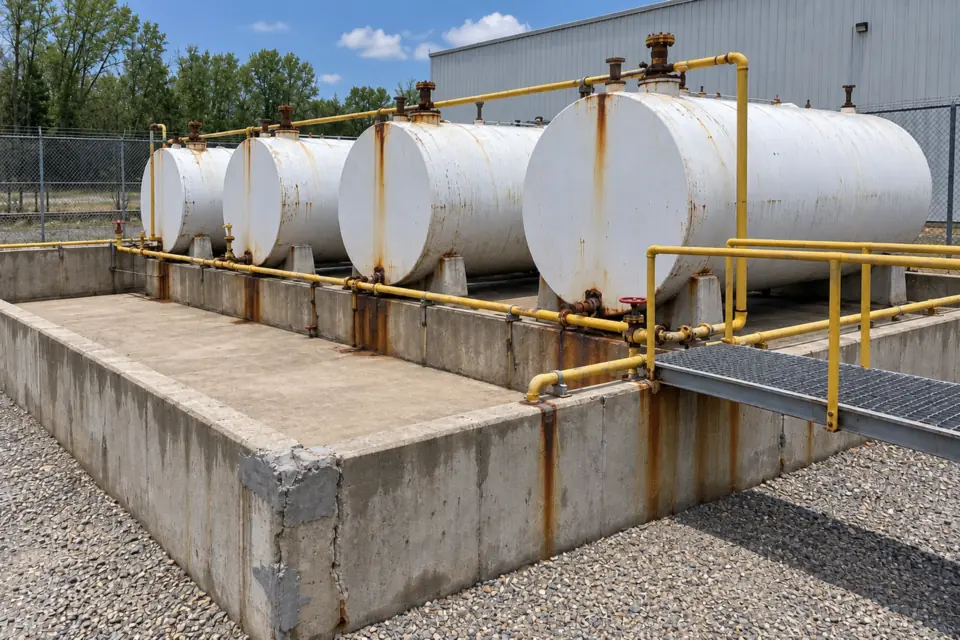
API 653 vs API 650 and Related Tank Standards
Tank operators often mix up API 653 with API 650, but the two cover completely different points in a tank lifecycle. API 650 is the new construction standard that tells the fabricator how to design, weld, and erect the tank from steel plate. API 653 governs the inspection, repair, alteration, and reconstruction of that same tank once it is commissioned.
Several related standards may apply alongside API 653. API 575 covers inspection of low-pressure storage tanks and is often referenced for cone-roof tank specifics. NFPA 30 sets fire-code requirements for flammable and combustible liquid storage. STI SP001 covers shop-built tanks, small field-erected tanks and portable containers such as drums and totes.
For underground storage tanks the standard changes entirely. UST inspection and testing is regulated under 40 CFR 280 and state UST programs rather than API 653. Operators with mixed aboveground and underground inventory should treat the two programs as separate compliance tracks. Our tank inspection and testing page walks through the UST side for one of the largest tank-bearing states in the country.
Cathodic protection on an AST sits in a parallel inspection track. Tanks resting on a sand or soil pad with impressed-current or sacrificial-anode protection require annual CP system testing per NACE SP0193 and STI R892, and that record sits alongside the API 653 file. The what a licensed UST contractor actually does overview covers what to expect from a qualified inspector engagement.
Cost Ranges by Tank Size and Inspection Type
AST inspection cost scales primarily with tank diameter, current condition, and whether the work is external or internal. External API 653 inspection on a typical 30,000 to 50,000 barrel terminal tank runs about $5,000 to $12,000 per tank for inspector fees. Owner cost for any access scaffolding or paint work to expose the shell sits on top of that base fee.
Internal evaluation is a different cost category because the tank has to be taken out of inventory, drained, cleaned, gas-freed, and re-certified for safe entry. Tank cleaning alone often runs $15,000 to $60,000 depending on residual sludge volume and waste disposal classification. Inspector fees for the full internal exam typically add another $15,000 to $40,000 per tank on a midsize terminal vessel.
Bottom plate replacement is the single largest repair scope that often follows an internal exam. Costs typically run $30 to $60 per square foot for partial replacement on a single-bottom design. A full new bottom installed over the existing floor as a double bottom with leak detection runs $50 to $90 per square foot. A 100-foot diameter tank holds roughly 7,800 square feet of bottom plate.
Operators planning a multi-tank inspection year should request bundled bids from API 653 certified inspector firms. Two or three tanks scheduled in sequence with a single mobilization can shave 15 to 25 percent off the per-tank inspection cost. The how to choose a UST contractor guide outlines what to look for when evaluating bids from qualified contractors.
How State and Federal Programs Reference API 653
EPA references API 653 through the SPCC rule at 40 CFR 112.8(c)(6). Under 40 CFR 112.1(d)(2), the capacity exemption applies only when a facility's aboveground oil storage is 1,320 gallons or less and its completely buried storage is 42,000 gallons or less. Buried tanks subject to all of the UST technical rules in 40 CFR 280, or an approved state program, do not count toward the 42,000, and only containers of 55 gallons or more count toward the aboveground total. The rule does not require API 653 by name but accepts it as an industry standard satisfying the integrity testing element. STI SP001 is the parallel option for smaller shop-built tanks.
Texas regulates aboveground petroleum storage tanks through the Texas Commission on Environmental Quality petroleum storage tank program. The Gulf Coast concentration of refineries and terminals between Houston and Beaumont gives Texas one of the largest AST populations in the country. Operators looking for inspectors can start with our Texas UST contractor directory and ask each firm whether it handles aboveground tanks.
Louisiana applies its own AST registration and inspection rules through the Department of Environmental Quality, with significant tank populations along the lower Mississippi River corridor and across the Lake Charles industrial zone. Our Louisiana UST contractor directory and the regional Louisiana tank inspection and testing services page are a place to start; ask each firm whether it handles aboveground integrity inspection as well as UST testing.
Other tank-heavy regions include the Permian Basin in west Texas and southeastern New Mexico, where producer field tanks and gathering terminals concentrate. The Midwest farm belt holds 12,000 to 30,000 gallon bulk plant tanks for fuel and fertilizer storage at thousands of cooperatives and dealers. The Bakken region in North Dakota adds significant producer tank inventory. Firms working in those regions can be shortlisted from the state by state directory.
Your Next Step: Hiring an API 653 Inspector
If your facility has more than 1,320 gallons of aboveground oil storage and you cannot locate records of container integrity testing, the integrity element of your SPCC plan may be out of compliance, because 40 CFR 112.8(c)(6) requires comparison records. The fix is to schedule an external review by a certified inspector and let that inspector reset the clock with a documented and stamped report.
When evaluating proposals, confirm the inspector holds a current API 653 certification, request a sample report, and ask about turnaround between field visit and final stamped report. Two to four weeks is typical for a clean external review. Internal work can run six to twelve weeks from completion of field inspection to final report depending on lab turnaround on UT data.
Multi-tank facilities should consider a risk-based inspection plan that schedules internal shutdowns across a multi-year window rather than a single outage. Spreading three or four tank exams across two or three years keeps a single product line online while the others rotate through inspection.
To request bids for API 653 work at your facility, request a quote and provide tank diameter, last inspection date, and product stored. Ask each firm that responds for its inspector's current API 653 certification and a scope letter with a preliminary budget range.