The steel shell of a heating oil tank is not something to patch. A weeping or rusted-through shell means a replacement tank, and so does a shell someone has already patched, while the fill and vent pipes, overfill whistle, gauge, filter, supply line, valves, legs and pad are ordinary repairs.
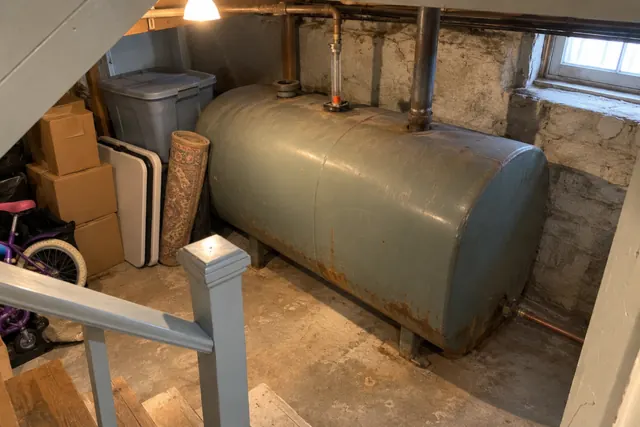
Oil tank repair is the work of fixing or swapping those attached parts while the tank itself stays in service. Federal tank regulation stays out of it, because 40 CFR 280.12 excludes a tank whose heating oil is burned on the same property where it is stored. State guidance and local fire codes fill that gap.
The question tends to arrive with a drip on the basement floor, a whistle that stayed quiet during a delivery, rust on the legs of an outdoor tank, or a flag in a home inspection report. Each of those can trace back to a part or to the shell, and a simple test of where the oil is coming from decides whether the next call is for a repair or a replacement.
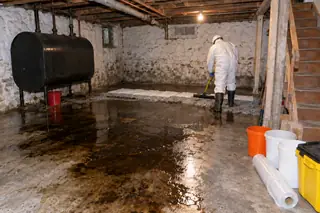
If oil is pooling on a floor or the ground today, the heating oil spill steps come before anything on this page.
Can an oil tank be repaired, or does it have to be replaced?
A tank can stay in service when oil is coming from a part attached to it, and it has to be replaced when the shell itself is weeping or rusted through. No federal repair standard covers a home tank, because 40 CFR 280 leaves home heating tanks out of the federal program, so the call rests on what the metal can still do.
Most corrosion in a steel oil tank starts on the inside, according to Maine's environmental agency: fine impurities in the fuel let water and sediment build up along the bottom, where they slowly eat away at the steel. The agency says corrosion is hard to judge from outside. By the time oil beads on the outer surface, the hole has usually been made from within, and the steel around it has been sitting in the same water. The agency's checklist adds that a bottom outlet "minimizes trapped water and reduces rust inside your tank."
An outside patch covers the symptom while the cause keeps working from inside.
Everything attached to the shell or sitting under it is a different story. The fill pipe, vent pipe, whistle, gauge, filter, valves, supply line, legs and pad can each be fixed or swapped while the body stays in place. Maine's tank FAQ treats fuel lines, the whistle, the gauge, the filter protector and the filter as ancillary equipment, separate from the tank. When the shell is the problem, the oil tank replacement guide picks up from there.
Which parts get an oil tank repair and which mean a new tank?
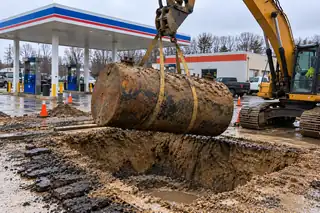
Only the shell, meaning the steel body with its seams and ends, calls for a new tank. Rust or pitting through the steel, an oily spot on the body that returns after the fittings are fixed, and any patch all point to replacement; excessive dents call for a technician's inspection. Crimped-end tanks need the same scrutiny. Maine's FAQ calls crimped ends weak welds, and says the style stopped being approved after an update to UL 80, the standard for steel oil-burner tanks. The same agency's checklist lists a crimped end as a warning sign.
The fittings on top are repairs. A vent blocked by ice or an insect nest gets cleared or fitted with a new cap. Spills around the fill pipe usually trace to an overfill, a loose cap or a loose joint, and each has a fix. An overfill whistle should sound while oil is going in, and Pennsylvania's self-inspection checklist flags one that stays silent during a fill, along with snow or ice that could fall on an outdoor tank. A gauge that is cracked or stuck, or has oil around it, gets swapped. Drips around the filter or valves mean a worn gasket or a failing filter or valve, which is oil burner technician work.
Down at floor level, the supply line gets flagged when it runs under concrete, or along the floor without a protective casing, and the fix is a sleeved or rerouted line. Legs rust and soil settles under the load, which the fuel weight calculator puts near a ton for 275 gallons of fuel oil. An outdoor tank on bare ground or wobbly legs therefore needs a concrete pad and often new legs; outdoor tank placement has its own guide. Water is the last thing to check, and a water-finding paste reading shows whether water is sitting under the oil now.
The parts can also hide each other. Oil from a dripping filter or gauge can run down the outside and look exactly like a weep from the body. Once the part is fixed, wipe everything clean and look again after a few days of normal use. An oily spot that comes back where no fitting sits is coming through the shell, and no oil tank repair will hold it.
| Part | What fails | Repair or new tank |
|---|---|---|
| Shell: steel body, seams and ends | Rust or pitting through the steel, an oily spot that returns after the fittings are fixed, any patch | New tank |
| Vent pipe | Blocked by ice or an insect nest | Repair: clear it or fit a new cap |
| Fill pipe | Spills around it after deliveries | Repair: fix the cap or joints, and check the vent |
| Overfill whistle | Silent during a fill | Repair, and check the vent |
| Gauge | Cracked or stuck, or oil around it | Repair: swap the gauge |
| Filter and valves | Drips around the filter or valves | Repair: gasket, filter or valve |
| Supply line | Runs under concrete or along the floor without a protective casing | Repair: sleeve or reroute the line |
| Legs and pad | Wobbly legs or a tank on bare ground | Repair: concrete pad and often new legs |
Is there a temporary fix for a weeping or leaking oil tank?
Yes, as a stopgap. Maine's spill guidance tells owners to plug holes when possible while they contain a leak, and an emergency oil tank repair of that kind does that job and nothing more. It cannot make corroded steel sound again.
The reason is the inside-out corrosion behind the weep. Anything pressed on from outside grips only the outer surface, while the water and sludge that made the hole are still sitting on the bottom, still working on the metal next to it. Pressure from a full tank also sits on that thin spot every day the patch is in place.
Those days are for lining up the replacement and for warning the fuel supplier, so a delivery does not top up a tank that is already weeping. Some states treat a weeping tank as a leak the owner must report right away, so check what state rules require before relying on a patch. A drip pan or absorbent pads under the spot catch what gets past it, and checking them each morning shows whether it is still holding.
The tradeoff is time against risk. A patch is quick and buys days, but left in place for a season it can turn a planned replacement into a spill cleanup.
Can an overfilled tank that weeps be saved?
Usually yes, when the oil came out of an opening on top rather than through the steel. An overfill pushes oil out through the vent or around the fill cap and gauge, and once those parts are fixed and the outside is cleaned, the tank can go back into service.
A silent whistle is the warning sign to look for. The whistle sounds while air is pushed out ahead of the incoming fuel, and Maine's checklist notes that a blocked vent can cause a silent overfill whistle. That makes a blocked fuel tank vent pipe the first thing to clear after an overfill.
A weep after an overfill needs one more check before anyone calls the tank saved. Clean it, then watch it through the next few days of use; oil that reappears on the bottom or a seam, away from the fittings, is coming through the shell, and the overfill only exposed it.
An overfill that put oil on the floor or outside the house is a spill first and a repair second.
Does a patched or fiberglassed tank bottom pass inspection?
A patch counts against a tank. Maine's tank checklist asks "Is the tank patched or showing signs of corrosion?" and says a yes means it "may be in danger of leaking or causing a spill."
Fiberglass or paint over the bottom hides the metal. Pennsylvania's homeowner tips warn that "a freshly painted tank does not mean that it is structurally sound," and a coated bottom is the same problem in thicker form. The same page lists what to look for: uniform corrosion, pitting, holes, leaking pipes, loose joints and loose fittings. A coated bottom answers none of those questions.
The check that can answer the corrosion questions is an ultrasonic thickness test, which measures steel thickness at several spots along the bottom centerline without opening it. Maine's environmental agency, which recommends the test, says to repeat it every year and warns that on older tanks it may no longer be effective, at which point it is time to consider a replacement. A heating oil tank inspection that includes this reading puts a number on the steel, where a visual check only describes the paint.
A coated or patched bottom gives any inspector a reason to flag it, and on an older tank even a thickness test may not settle the question.
Who fixes oil tank fill and vent pipes, gauges and supply lines?
An oil burner technician fixes the parts on an aboveground or basement tank: fill and vent pipes, whistle, gauge, filter, valves and the supply line. Pennsylvania's guidance points to the same trade, saying any yes on its self-inspection checklist calls for "an oil burner technician for a more detailed inspection and corrective measures." Maine's checklist adds the local fuel supplier as the other call.
The fill pipe needs attention even after a tank is gone. Pennsylvania's guidance says the fill line should come out after the tank is removed; where it cannot, both ends get sealed permanently, and either way the oil company is told. Oil has been delivered through fill pipes for tanks that no longer exist, with the oil going straight into the basement.
Buried tanks are a different job. Nobody can see a buried shell. A buried home tank sits far past the 10% underground line in 40 CFR 280.12, but the exclusion for home heating tanks means 40 CFR 280 requires no leak detection on it. The warning signs are therefore indirect: using more oil than normal, a blocked vent, a silent whistle, and water building up under the oil. Confirming the condition takes testing, such as the tank tightness work described in the underground storage tank inspection guide, and a tank that is only suspected to be buried has to be found first.
Work on a buried tank usually goes to a tank removal or closure contractor instead of the heating service. Firms that do this work are listed state by state in the UST contractor directory, and the oil tank removal hub has a state picker for the job itself.
What do state rules require when a heating oil tank leaks?
State rules and local fire codes govern a leaking home heating oil tank, and new installations generally follow NFPA 31, which covers installing oil-burning equipment, where the local code adopts it. Under 40 CFR 280.12, an underground storage tank is one with 10% or more of its volume, counting connected underground pipes, beneath the ground. A buried home tank clears that 10% line easily and is still excluded, because the definition leaves out heating oil burned on the property where it is stored. Another 40 CFR 280.12 exclusion covers a basement or cellar tank sitting on or above the floor, and a third covers farm or residential tanks of 1,100 gallons or less that hold motor fuel for noncommercial use. Spill prevention rules step aside too: 40 CFR 112.1 does not apply at all to heating oil used solely at a single-family residence, and it exempts sites with 1,320 gallons or less above ground and limited buried storage. Once oil tank leakage reaches a floor or the soil, state reporting and cleanup rules take over.
New York sets a short clock once oil is out of the tank. All petroleum spills in the state must be reported to the NYS Spill Hotline within two hours of discovery, according to the state's spill FAQ. The exception needs all four of the FAQ's conditions: a known amount under its small-spill limit, kept contained and under the spiller's control, kept off soil and water, and cleaned up within two hours. The responsible party or the property owner is required to report.
Massachusetts regulates the supply line itself. Under a state fire safety law, a homeowner whose fuel supply or return lines touch concrete, earth or a floor has to protect the supply line. The options are a continuous non-metallic sleeve around it, an oil safety valve at the tank end, or another release prevention method the fire prevention board approves. Section 38J defines an oil safety valve as "a device that prevents the flow of oil if a fuel supply line breaks," which is the failure the whole section guards against. The upgrade is not required when the burner sits higher than the tank and the whole line runs above its top, or when the lines were already upgraded and certified, and the law excludes underground tanks. A licensed oil burner technician inspects and certifies the work, and the owner submits the certification to the local fire department.
Pennsylvania's instruction for a leaking home tank is blunt: its guidance tells the owner to contact the Department of Environmental Protection immediately, find the source, stop or contain the release, and begin cleanup. Buried tanks add one more decision, between removal and closure in place, made under the state rules for heating oil tanks.