After a full switch from oil to heat pump, the tank needs emptying and closing. Nothing in federal law forces that work, because 40 CFR 280.12 leaves heating oil tanks used on the premises out of the federal UST rules. The rebate program and state and local closure rules decide the rest, and several programs pay more (or pay at all) only when the oil system is decommissioned.
An oil furnace to heat pump conversion is the replacement of an oil-fired furnace or boiler with an electric heat pump as the main source of space heat. The heat pump is HVAC work; emptying the tank and then removing or filling it is tank contractor work, with its own quote.
The recommendation here is plain: do not leave the tank sitting unclosed. Take it out through a proper oil tank removal or close it in place, as part of the switch.
Keeping oil as backup heat is the honest alternative, allowed by several programs for a smaller rebate. Con Edison's 2026 single-family figures in New York, outside disadvantaged communities, show the gap: $7,000 or more for full decommissioning, $2,500 when oil stays as backup with integrated controls.
Do You Have to Remove the Oil Tank When You Switch From Oil to Heat Pump?
Removal is optional under federal law. The federal UST rules exclude tanks that hold heating oil burned on the same premises where it is stored (40 CFR 280.12). A home heating oil tank therefore sits outside the EPA underground storage tank program that covers gas station tanks. Two sets of rules apply instead: the terms of the rebate program paying for the heat pump, and the tank closure rules of your state and town.
Local code can settle the question outright. Con Edison guidance states that NYC Fire Code requires out-of-use tanks to be disabled in place or removed, so in New York City leaving the tank as it was is off the table. Requirements elsewhere differ, and the heating oil tank removal guide sets out when states require removal. The local fire marshal or building department can say whether the tank work needs a permit in a given town.
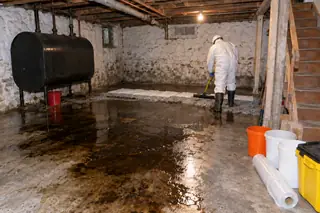
An unclosed tank is one that is out of use but still holds oil, with its fill pipe open and no closure record. That is the outcome to avoid.
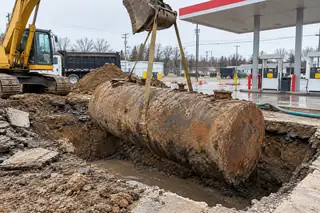
There are two ways to take a tank out of service: removal and closure in place, each done under whatever closure rules the state or town sets. The tank decommissioning vs removal comparison covers which one suits which property.
What Do Heat Pump Rebates Require for the Old Oil System?
Within programs that tier their rebates, the higher tier requires the oil system to be decommissioned and the lower one lets it stay as backup behind an integrated control. Some programs pay their full rebate with oil kept as backup. Decommissioning, in program language, means the heat pump becomes the only space heat and the oil equipment is removed or permanently disabled. The table below sets out the verified terms program by program, and the programs whose terms we could not verify are listed after it. The paragraphs here cover the programs with the most specific tank language.
New York's NYS Clean Heat program writes the tank rule out in full. Its 2026 program manual, Version 3 dated September 1, 2026, defines Category 2b as a full-load heat pump with decommissioning. The legacy fossil system must be decommissioned so the heat pump is the only space heating. When oil will no longer be used, the tank is removed, which the manual calls best practice, with the vent line removed and the fill line removed or capped. The other route is permanent decommissioning in place: emptied, vapors purged, filled with an inert material such as sand, and the fill line removed or capped. New York owners lining up Category 2b tank work can compare firms on the New York oil tank removal page.
JCP&L's Clean Comfort Program in New Jersey, for equipment installed from February 1, 2026 to June 30, 2027, takes the same approach on full-displacement projects. Existing fossil equipment must be completely removed or completely and permanently disabled. With oil, the tank is removed from the property or, if left, capped per applicable codes, and the customer notifies the fuel delivery company. A decommissioning incentive of up to $2,000 is paid on full-displacement projects, though tank removal is not itemized separately.
Households in New York that qualify on income can get tank money through NYSERDA's income-eligible home energy program. The existing whole-house fossil system must be decommissioned. So must the oil tank and fill pipe, per code. When the tank is removed with the conversion, the program covers the removal at 100% up to a cap. For a low-income household the cap is $2,000 for an above-ground tank and $5,000 for a below-ground tank, and for moderate income it is $1,000 and $2,500.
| Program | Program year | What it requires for the old oil system | Oil tank work | Terms |
|---|---|---|---|---|
| NYS Clean Heat Statewide Heat Pump Program, upstate utilities except O&R (New York) | 2026 | Decommissioned for the higher Category 2b rebate | Removed, or permanently decommissioned in place, when oil is no longer used | Program terms |
| NYS Clean Heat Statewide Heat Pump Program, Orange & Rockland (New York) | 2026 | Decommissioned for the decommissioning tier; may stay under Category 2 | Removed, or permanently decommissioned in place, when oil is no longer used | Program terms |
| NYS Clean Heat Statewide Heat Pump Program, Con Edison (New York) | 2026 | Decommissioned for Category 2b; may stay as backup under Category 2a | Drain and remove, or fill with inert material; signed attestation if left in place | Program terms |
| NYSERDA EmPower+ (New York) | 2026 | Decommissioned | Decommissioned per code; removal covered up to $2,000 above ground or $5,000 below ground (low income) | Program terms |
| PSEG Long Island Home Comfort heat pump rebates (New York) | Not stated | May stay as backup with integrated controls, or be removed | Check current terms | Program terms |
| JCP&L Clean Comfort Program (New Jersey) | 2026 to mid-2027 | Decommissioned for full displacement; may stay as backup on the dual-fuel tier | Removed or capped (full displacement); decommissioning incentive up to $2,000, tank not itemized | Program terms |
| Atlantic City Electric Residential Electrification (New Jersey) | Not stated | Full displacement (decommissioning incentive) or dual fuel (lower rebate) | Decommissioning incentive of 50% of itemized costs up to $2,000; tank not named | Program terms |
| Rockland Electric (New Jersey) | Not stated | Check current terms | Decommissioning incentive of 50% of itemized costs up to $2,000; tank not named | Program terms |
| Efficiency Maine Mobile Home Initiative (Maine) | 2026 | Removed | Removal optional; Maine DEP pays $400 to the homeowner and $400 to the heating oil contractor | Program terms |
| Efficiency Maine Whole-Home Heat Pump Rebates (Maine) | 2026 | May stay only as emergency backup | Check current terms | Program terms |
| Efficiency Maine Residential Ducted Heat Pump Rebates (Maine) | 2026 | Forced hot air furnaces must be removed | Check current terms | Program terms |
| Clean Heat Rhode Island (Rhode Island) | 2026 program | May stay as backup; no removal required | Not covered: the incentive pays only for the heat pump work | Program terms |
| Efficiency Vermont Integrated Controls for Residential Ductless Heat Pumps (Vermont) | 2026 | Must remain (integrated controls) | Does not pay for tank removal | Program terms |
| BGE EmPOWER Maryland electrification incentives (Maryland) | Not stated | Replaces the existing oil, gas or propane system | Check current terms | Program terms |
| Delmarva Power (Maryland) | Not stated | May stay as backup (hybrid projects qualify) | Check current terms | Program terms |
| Pepco (Maryland) | Not stated | May stay as backup (hybrid projects qualify) | Check current terms | Program terms |
| Potomac Edison (Maryland) | through December 31, 2026 | May stay as backup, for a lower incentive | Check current terms | Program terms |
| Mass Save Heat Pump Rebates (Massachusetts) | 2026 | Whole home: removed or disconnected. Partial home: may stay as backup with integrated controls | Check current terms | Program terms |
| Mass Save Enhanced (Massachusetts) | 2026 | Partial home: may stay as backup with integrated controls. Whole home: removed or disconnected | Check current terms | Program terms |
| PECO Home Rebates, Air Source Heat Pump and Ductless Mini-Split Heat Pump rebates (Pennsylvania) | Phase V, June 1, 2026 through May 31, 2031 | Replaces an existing system; a supplemental source may remain | Check current terms | Program terms |
| PPL Electric Utilities Residential Energy Efficiency Program, Air-Source Heat Pump rebate (Pennsylvania) | Phase V promotion dates June 1, 2026 to May 31, 2031 | Oil furnace accepted as the replaced system; removal may be checked | Check current terms | Program terms |
| Program | Terms |
|---|---|
| ACES (Alaska) | Check current terms |
| Chugach Electric Heat Pump Incentive (Alaska) | Check current terms |
| Energize CT Residential Heat Pump Rebates (Connecticut) | Check current terms |
| New England Heat Pump Accelerator (Connecticut) | Check current terms |
| Energize Delaware Home Performance with ENERGY STAR (Delaware) | Check current terms |
| DNREC Green Energy Program, Geothermal Heat Pump Grants (Delaware) | Check current terms |
| SMECO Heating and Cooling Rebates (Maryland) | Check current terms |
| Maryland Energy Administration Residential Energy Equity Heat Pumps (Maryland) | Check current terms |
| DOER Alternative Energy Certificates (Massachusetts) | Check current terms |
| NHSaves Residential Heating and Cooling Equipment Rebates (New Hampshire) | Check current terms |
| New Hampshire Electric Cooperative (New Hampshire) | Check current terms |
| PSE&G HVAC Instant Rebates Program, Residential Building Decarbonization (New Jersey) | Check current terms |
| Duquesne Light Watt Choices residential HVAC rebates (Pennsylvania) | Check current terms |
| Rhode Island Energy Residential Electric Heat Pump Rebates (Rhode Island) | Check current terms |
| Efficiency Vermont heat pump discounts and rebates (Vermont) | Check current terms |
| Green Mountain Power income-eligible heat pump rebate (Vermont) | Check current terms |
| Burlington Electric Department (Vermont) | Check current terms |
Mass Save Oil Tank Replacement: What the Massachusetts Rebate Covers
Mass Save's 2026 rebates pay for the heat pump and set a rule for the old heating system; for the tank itself, check Mass Save's current terms. The whole-home rebate requires the pre-existing heating system to be removed or disconnected, and a fuel line disconnected and capped is one of the listed options. The old system may remain only to make domestic hot water, with space heating disabled.
Mass Save pays $2,650 per ton up to $8,500 for a whole-home air source system, and the income-based Enhanced rebate goes up to $16,000. Because the Massachusetts heating-system condition can be met with a capped fuel line, price the tank work as its own job on oil tank removal in Massachusetts.
Take a whole-home job where the installer caps the fuel line. The rebate condition is met and the boiler is cold, yet the tank still holds whatever oil was in it, and the fill pipe outside is still in place.
Partial-home rebates work differently. The oil system may stay as backup if a qualified integrated control manages the handoff between the two heat sources, which keeps the tank in service and postpones the closure decision.
Can You Keep Oil as Backup Heat?
Yes, several programs allow oil to stay as backup heat, and the tradeoff is a smaller rebate. In Con Edison territory, the 2026 single-family rebate for Category 2b, full decommissioning, is $7,000 at the base level or $10,000 at the weatherized tier, outside disadvantaged communities. Category 2a, where the fossil system stays with integrated controls, pays $2,500.
Outside disadvantaged communities, the 2026 backup tier in Con Edison territory pays a little over a third of the base decommissioning rebate.
Backup tiers exist elsewhere on similar terms. Mass Save allows oil backup under its partial-home rebate with a qualified integrated control, and JCP&L's dual-fuel tier keeps the system for a lower rebate. NYS Clean Heat's Category 2 (2a in Con Edison territory) is the program-manual version of the same idea, keeping the existing system as backup with integrated controls.
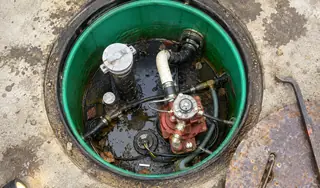
An integrated control runs the heat pump first and brings in the oil system below a set balance point. The tank stays in service the whole time. It takes deliveries, needs the upkeep any working tank needs and keeps its fill pipe and vent in use. The closure question returns when the oil system finally comes out.
What Happens to the Oil Left in the Tank, and Who Closes It?
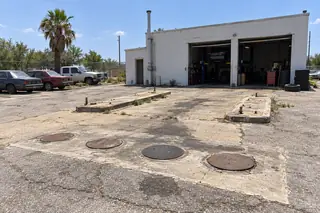
A tank contractor pumps out the remaining oil and then removes the tank or fills it with inert material and leaves it. Ask whether the heat pump quote includes the tank work; if it does not, the tank needs its own contractor and its own price. Closure in place makes sense when the tank sits under a slab or an addition, where removal means breaking up whatever is on top.
Con Edison's checklist spells the choice out for its customers. The checklist says that when oil will no longer be used in the home, the tank is drained and removed or filled with an inert substance, in either case per applicable code. Removal is recommended but not required, and a customer who leaves the tank must sign the "Leaving Oil Tanks When Switching to Heat Pumps" attestation.
Maine sets out the tank work in detail for income-eligible single-wide mobile homes. Under the Efficiency Maine Mobile Home Initiative, paired with a Maine DEP fuel tank removal rebate, tank removal is optional. An above-ground tank removed for the rebate must be drained of all fuel and sludge, disassembled and cleaned, with all piping removed and disposed of. The rebate is $400 to the homeowner plus $400 to the heating oil contractor, for tanks removed after April 23, 2025.
Payment toward the tank, where a program offers it, comes as a fixed or capped amount, such as the NYSERDA caps and the Maine $400 pair. Any tank cost those amounts leave uncovered falls to the owner. To find a firm that drains and removes residential tanks, open the UST contractor directory and pick the state the house is in. A quote request should give the tank's size and location and the rebate tier the project is aiming for.
Is There Still a Federal Tax Credit or Rebate?
The federal tax credit no longer applies to new installations. According to the IRS page on the Energy Efficient Home Improvement Credit, the 25C credit can be claimed for improvements made through December 31, 2025, so a heat pump installed in 2026 does not qualify.
For heating oil alternatives, the federal rebate program is the Home Electrification and Appliance Rebates, known as HEAR, which reach homeowners only where a state has launched them. New York launched on November 21, 2024 for income-eligible households, through the Appliance Upgrade Program and NYSERDA's income-eligible program, though inside NYSERDA's program it currently pays only for insulation, ventilation and air sealing on projects without heat pumps.
Elsewhere the scope is narrower. Maine's launch on September 18, 2024 covers only new affordable multifamily construction and single-wide mobile homes. Rhode Island's, from September 2024, covers panels, wiring, dryers and electric cooking for LIHEAP-enrolled households, and leaves out space-heating heat pumps.
HEAR had not launched in Alaska, Connecticut, Delaware, Maryland, Pennsylvania and Vermont, and no launch had been confirmed in New Jersey, as of the dates these programs were checked.
Should You Remove the Oil Tank or Close It in Place?
Remove the tank when it can be reached, and close it in place when it cannot. Removal is what the NYS Clean Heat manual calls best practice and what Con Edison recommends, and it leaves no tank behind for a future buyer to ask about. A closure leaves an emptied, filled tank where it is, along with a record that the work was done.
Timing matters on the tiers that require decommissioning. Under NYS Clean Heat Category 2b and JCP&L's full-displacement tier, the oil system has to be decommissioned for the higher rebate, so the tank work belongs inside the heat pump project. Under a tier that asks only for a disconnection, the rebate condition can be met while the tank still holds oil, which is how a capped fuel line turns into a tank nobody closes.
The exception is a house that keeps oil for hot water. Mass Save lets the old system stay for domestic hot water with space heating disabled, and a tank feeding that boiler is still a working tank, so closure waits until the hot water moves off oil too. A house switching to gas instead faces the same tank question from another direction, and the oil to gas conversion guide covers that route.
One rule settles most cases. Once a switch from oil to heat pump leaves the heat pump as the only heat, the tank has no job left and should be removed, or closed in place with a record, in the same project. A tank still feeding backup heat or hot water stays in service. Anything in between is an unclosed tank.