

What to Know About Tank Decommissioning in Michigan
This page covers tank decommissioning in Michigan for commercial and home tanks. A regulated underground storage tank (UST) falls under Part 211 of NREPA and the Michigan Underground Storage Tank Rules. The Storage Tank Division of the Department of Licensing and Regulatory Affairs (LARA) Bureau of Fire Services runs that program. The Department of Environment, Great Lakes, and Energy (EGLE) runs the Leaking Underground Storage Tanks Program for cleanup after a release under Part 213, and its page says non-leaking tanks are regulated by LARA. Part 211 does not cover a tank storing heating oil for use on the premises, at a home or a business, and sets no size cap for that exclusion. It also excludes farm or residential tanks of 1,100 gallons or less that store motor fuel for noncommercial use.
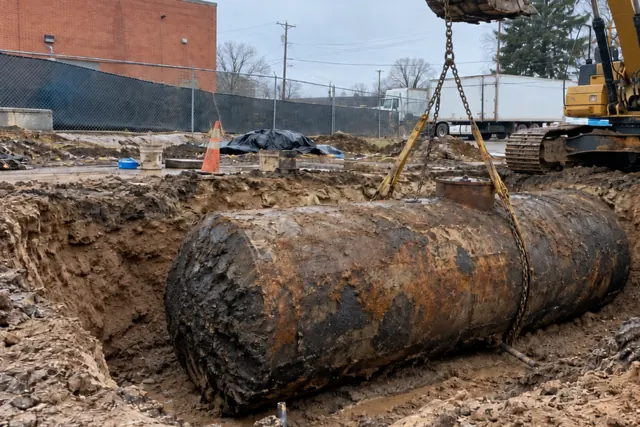
Tank closure starts with form BFS-3824, which LARA's Lansing office must receive at least 30 days before work begins. R 29.2153 also requires notice to the inspector at least 2 working days before the closure, and LARA's approval is valid for 6 months. The tank is emptied, cleaned, purged of vapors and removed from the ground. Closure in place is allowed only when removal would jeopardize a building or structure above or near the tank, and the tank is then filled with an inert solid. A site assessment is required at closure unless a confirmed release has been reported, and R 29.2155 requires the results within 45 days of sampling on form BFS-3881, sent to LARA. Fuel seen or smelled in the excavation is a confirmed release, which must be reported to LARA within 24 hours. LARA's form instructions also call for an amended registration within 30 days of closure. A substandard tank in temporary closure for more than 12 months must be closed unless LARA grants an extension.
The Michigan Underground Storage Tank Authority (MUSTA), a body within EGLE, manages the Underground Storage Tank Cleanup Fund under Part 215. It pays for corrective action after a release from a refined petroleum UST that was discovered and reported on or after December 30, 2014. The tank must have been registered, the release reported within 24 hours, and financial responsibility in place when the release was found. The claims limit is $1,000,000 per release, minus the deductible. The fund does not pay for UST removal or a clean tank closure. Breaking Part 211 or its rules, including the closure notice, can bring a civil fine of up to $5,000 per tank system for each day of violation. Read closure in place versus UST removal before choosing a method.
A home heating oil tank follows different rules. LARA's home heating oil FAQ says residential heating oil tanks fall under the state's flammable and combustible liquids rules. Its steps are to empty the tank and cap the pipes, have it cleaned, ask local authorities whether a permit is needed to excavate, and remove the tank unless removal would threaten a nearby building. A tank left in the ground is filled with sand, gravel or cement. EGLE's heating oil brochure says an unused heating oil UST must be removed within one year of its last use. For regulated USTs, MCL 324.21109 bars local ordinances that require a permit, inspection or fee for closure or removal. LARA's permits and licenses page lists no license for tank removers, so ask each firm for its insurance certificate and closure documentation from recent tank decommissioning jobs.